The #1 Mistake People Make When Building Solar Backup for Hurricane Season
Jun 11, 2026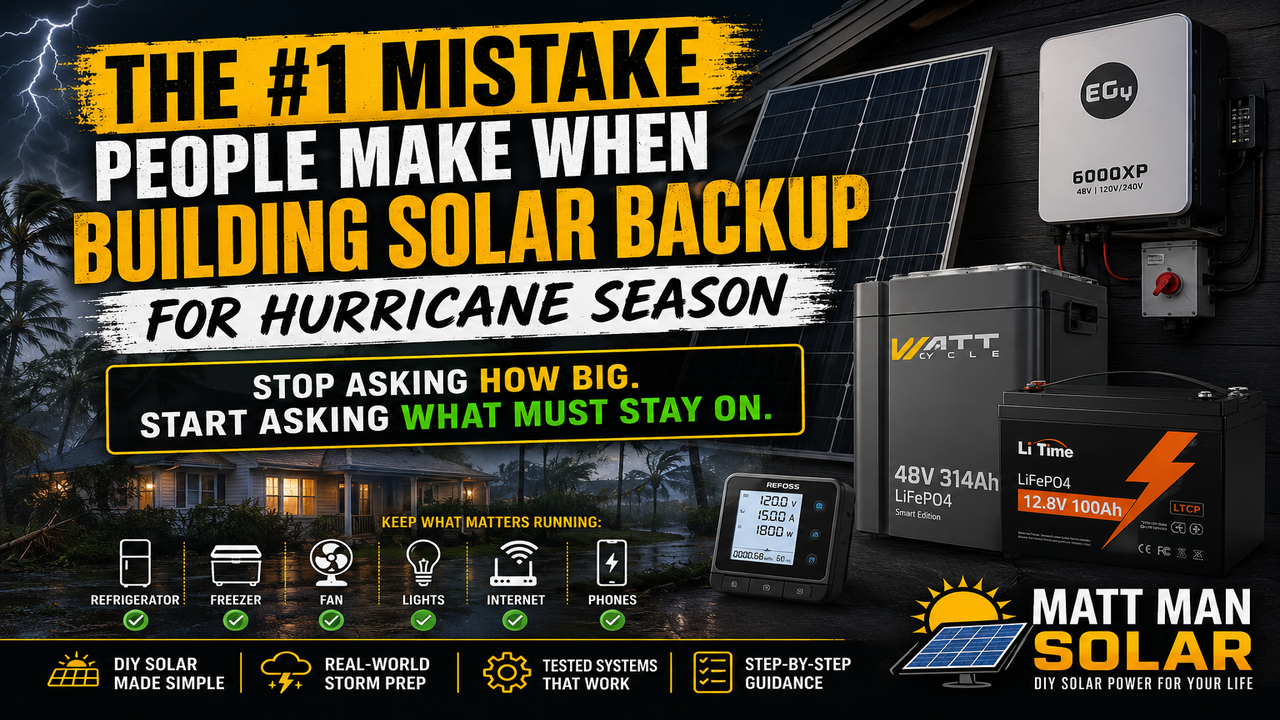
Stop asking how big your solar system needs to be. Start asking what absolutely has to stay on.
Every hurricane season, people start asking the same question:
“How big of a solar system do I need to run my house?”
That sounds like the right question, but for most DIY solar backup systems, it is actually the wrong place to start.
A better question is:
“What do I absolutely need to keep running when the power goes out?”
That one change in thinking can save you thousands of dollars, help you build a system that actually works, and keep you from buying equipment that looks good on paper but fails when you need it most.
When a storm knocks out the grid, your goal usually is not to live exactly like normal. Your real goal is to keep food cold, keep phones charged, keep lights on, run a fan, keep internet or communication gear alive if service is available, and maybe power one comfort load like a small window AC, CPAP machine, or freezer.
That is where DIY solar backup becomes powerful.
Not because it replaces every generator or every whole-house battery system, but because it gives you options when fuel is hard to find, the grid is down, and the heat is starting to build.
Before we go further, quick disclosure: some of the product links in this article may be affiliate links. That means MattMan Solar may earn a small commission if you purchase through them, at no extra cost to you. Those commissions help support future videos, testing, and DIY solar builds.
The Real Problem After a Hurricane
The storm itself is only part of the problem. The bigger issue is often what happens afterward.
The power goes out. Gas stations are packed or closed. Roads may be blocked. Generators are loud, hot, and need fuel. Extension cords get run through windows. Refrigerators start warming up. Freezers begin thawing. Phones die. Internet routers shut off. Fans stop moving air.
In Florida and other storm-prone areas, this is not a theory. This is something many families deal with year after year.
That is why I like to build solar backup systems around critical loads first.
A critical load is something that actually matters during an outage. For most people, that list starts with:
Refrigerator
Freezer
Phones
LED lights
Fan
Internet router or modem
Medical device if needed
Small cooking or charging station
Small AC only if the system is sized for it
Notice what is not first on the list: the entire house.
That is where people get in trouble. They want to run everything, so they either overspend or they build a system that is too small for the job. Then when the outage happens, the system does not perform the way they expected.
Start With the Refrigerator
If you are new to DIY solar backup, the refrigerator is one of the best first goals.
Why?
Because it protects food, medicine, and normal life. It is also a load most people understand. You do not need to explain why a refrigerator matters during a power outage. Everyone gets it.
A modern refrigerator may average around 1 to 2 kilowatt-hours per day, depending on size, age, temperature, door openings, and how hot the house gets. A garage refrigerator or older unit may use more. A freezer may use less or more depending on conditions.
But the important thing is this: a refrigerator does not run constantly. It cycles on and off. That means you need enough inverter power to handle startup surge, and enough battery capacity to keep it running overnight.
This is where a lot of small backup systems fail. People buy a battery box or portable power station because the label says it has a big number, but they do not check the inverter surge rating, battery capacity, solar recharge rate, or real-world runtime.
A good hurricane backup plan should answer three questions:
Can it start the refrigerator?
Can it run the refrigerator overnight?
Can it recharge enough the next day from solar?
If the answer to any of those is no, the system needs work.
If you are just getting started and want a simple place to begin, I recommend grabbing my free solar diagram and refrigerator backup diagram here:
Free Solar Diagram / Refrigerator Backup Diagram:
https://classes.mattmansolar.com/solar-equipment/
That page also has the equipment I use and recommend on the MattMan Solar channel.
Battery Size: Think in Kilowatt-Hours
Battery capacity is the fuel tank of your backup system.
A lot of people think in amp-hours, but for comparing systems, kilowatt-hours are usually easier.
A 12V 100Ah LiFePO4 battery is roughly 1.28 kWh before losses.
A 24V 100Ah LiFePO4 battery is roughly 2.56 kWh before losses.
A 48V 100Ah LiFePO4 battery is roughly 5.12 kWh before losses.
For a basic refrigerator backup system, I like to see people thinking in the 2 kWh to 4 kWh range or larger, depending on what they want to run. That may not power the whole house, but it can keep the important stuff alive long enough for solar to recharge the next day.
For bigger systems, 48V becomes very attractive. Once you start talking about larger inverters, longer wire runs, or whole critical-load backup, 48V usually makes more sense because the current is lower for the same amount of power.
One battery option I have been using and discussing is the Watt Cycle 48V 314Ah wall-mount battery. It is a large-format home battery style option that makes sense for bigger backup builds, solar sheds, and home energy storage projects.
Watt Cycle 48V 314Ah Wall Mount Battery
Discount Code: MATT
Link: https://classes.mattmansolar.com/solar-equipment/
For smaller systems, LiTime batteries are also worth looking at. They are a popular value option in the DIY LiFePO4 space.
LiTime Batteries
Discount Code: MMS8 for 8% off
Link: https://classes.mattmansolar.com/solar-equipment/
If you want a larger EG4-style system, rack batteries, inverters, panels, and wiring, Signature Solar is one of the main places I point people.
Signature Solar
Discount Code: MMS50
$50 off orders over $500
Link: https://classes.mattmansolar.com/solar-equipment/
Shop Solar Kits is another option for people who want more of a kit-style path instead of piecing every part together.
Shop Solar Kits
Discount Code: MATTHEWMCINTOSH101
$101 off
Link: https://shopsolarkits.com/discount/MATTHEWMCINTOSH101?ref=MattMan
The right battery depends on your build, but the key is simple: do not buy a battery until you know what loads you are trying to run.
The Inverter Has to Match the Job
The inverter converts battery power into household AC power.
This is the part that lets you plug in a refrigerator, freezer, fan, router, charger, or other normal appliance. But not all inverters are created equal.
For hurricane backup, you need to think about two numbers:
Continuous watts
Surge watts
A refrigerator may not use a lot of power once running, but it can require a higher surge when the compressor starts. The same is true for freezers, pumps, and some power tools.
For small backup systems, a 1,000W to 2,000W pure sine wave inverter may be enough for basic loads. For larger home backup, RV systems, sheds, or critical-load panels, you may be looking at 3,000W, 6,000W, 10,000W, or more.
One of the inverters I use in larger 48V builds is the EG4 6000XP. It is a strong option for off-grid, solar shed, RV, and larger backup systems.
EG4 6000XP Inverter
Discount Code for Signature Solar: MMS50
Link: https://classes.mattmansolar.com/solar-equipment/
For people building bigger systems, the EG4 12000XP, FlexBOSS 18, and FlexBOSS 21 are also worth looking at depending on the project.
For a more budget-focused 48V hybrid inverter, I have also listed the ZLPOWER 48V Hybrid Solar Inverter 10KW on my equipment page.
ZLPOWER 48V Hybrid Solar Inverter 10KW
Link: https://classes.mattmansolar.com/solar-equipment/
But here is the warning: do not oversize the inverter just because bigger sounds better.
A giant inverter on a small battery bank can drain the battery quickly. A big inverter can also require larger wire, larger fuses, proper busbars, and better planning. The inverter should match the loads, the battery bank, and the wiring.
Solar Panels: The Part That Keeps You Going
A battery gets you through the night.
Solar gets you through day two, day three, and beyond.
This is one of the biggest differences between a battery backup system and a solar backup system. If you only have a battery, you have a countdown timer. Once the battery is empty, you are done until the grid or generator comes back.
Solar gives you a way to refill the tank.
But you have to be realistic. A 400W solar panel does not produce 400W all day. Clouds, rain, heat, shade, panel angle, wire losses, charge controller efficiency, and storm debris all reduce production.
After a hurricane, conditions may not be perfect. You may have cloudy weather, branches down, or panels that need to be moved into the sun. This is why I like to design with extra solar whenever possible.
If you are trying to keep a refrigerator, freezer, lights, fan, phones, and internet running, several hundred watts of solar can help. If you want to run comfort loads like a small AC, you need more battery and a lot more solar.
On my equipment page, I list panel options like Aptos bifacial panels, URN panels, and smaller Eco-Worthy style panels depending on the build.
Solar Panels and PV Wire Options
Link: https://classes.mattmansolar.com/solar-equipment/
If you are building a permanent ground mount, also look at the mounting section. Racking matters a lot in storm areas. A solar panel that is not mounted properly can become a problem in high wind.
Do Not Ignore the Small Parts
A solar backup system is not just a battery, inverter, and panels.
The small parts are what make the system safe and reliable.
That includes:
Correct wire size
Battery fuse
PV disconnect
Battery disconnect
Busbars
Breakers
Lugs
Crimping tools
Shunt or battery monitor
Labels
Torque tools
Multimeter
Solar panel tester
This is where DIY systems often separate into two groups: systems that work for a quick test, and systems you can actually trust.
If you are building battery cables, use a proper hydraulic lug crimper. If you are connecting multiple batteries or large cables, use properly rated busbars. If you are protecting battery cables, use the right fuse or breaker close to the battery. If you want accurate state-of-charge information, use a shunt.
A few tools and components I recommend looking at:
Hydraulic Lug Crimper
Victron 500A SmartShunt
Busbars
DIHOOL DC Breakers
PV Wire
Battery Wire
MRBF / ANL / T-Class Fuse Options
Multimeter and Clamp Meter
MC4 Crimping Tool
ZIBOO Solar Panel Tester
Link: https://classes.mattmansolar.com/solar-equipment/
For monitoring plug-in loads or checking what your refrigerator actually uses, the Refoss power monitor is also useful.
Refoss Power Monitor
Discount Code: MSOLAR8 for 8% off
Link: https://classes.mattmansolar.com/solar-equipment/
Before you guess what your refrigerator uses, measure it. Real data beats internet guesses every time.
The Dangerous Shortcut: Backfeeding
Let’s be clear.
Do not backfeed your house with a homemade cord.
Do not plug an inverter into a dryer outlet.
Do not make a male-to-male “suicide cord.”
Do not energize your home wiring unless you have a proper transfer switch, interlock, critical-load panel, or approved method that isolates your system from the grid.
This is not just about protecting your equipment. It is about protecting utility workers, your family, your home, and first responders.
If you want to power household circuits, plan the transfer method correctly. That may mean using a transfer switch, interlock kit, subpanel, or having an electrician help with the AC side.
DIY solar can be safe, but only if we respect the electrical side.
My Favorite Beginner Strategy
For most people, I would not start with “run the whole house.”
I would start with a realistic emergency backup goal:
Keep the refrigerator running.
Keep phones charged.
Keep a fan running.
Keep lights on.
Keep communication alive.
Recharge from solar.
That kind of system is achievable, expandable, and useful.
Once you understand that system, you can grow into a bigger build. Maybe you add more panels. Maybe you move from 12V to 24V or 48V. Maybe you add a larger inverter. Maybe you build a solar shed. Maybe you add a critical-loads panel. Maybe you eventually build a system around an EG4 6000XP or larger inverter.
But the best system is the one you understand before the storm hits.
Test Before You Need It
The first time you test your hurricane backup system should not be during a hurricane.
Do a real test.
Plug in the refrigerator. Run it overnight. Check how much battery is left in the morning. Recharge from solar the next day. Try it on a cloudy day. Run the fan. Charge phones. Test the internet router. Label the cables. Make sure your family knows how to turn it on and off.
A system that has been tested is worth more than a larger system that only exists in theory.
Also keep your gear organized. Store adapters, extension cords, spare fuses, MC4 tools, labels, manuals, and emergency instructions together. During an outage, confusion is the enemy.
Final Thought
The biggest mistake people make with hurricane solar backup is asking, “How big does my system need to be?”
The better question is, “What has to stay on?”
Once you answer that, the system becomes much easier to design.
Start with the critical loads. Size the battery. Pick the inverter. Add enough solar to recharge. Use proper wire, fuses, breakers, and disconnects. Test it before the storm.
You do not need to power everything to be prepared.
You need to power the right things.
If you want help getting started, grab the free solar diagram, refrigerator backup diagram, and recommended equipment list here:
MattMan Solar Recommended Equipment and Free Diagrams
https://classes.mattmansolar.com/solar-equipment/
And if you want a second set of eyes before buying parts, you can schedule a 1-on-1 solar strategy call from that same page.
Build it before you need it. Test it before the storm. And when the grid goes down, you will be glad you did.
DIY Solar Class
DIY Solar Class — Design, Wire & Power Your Own Solar System Learn step-by-step how to build or expand your solar power setup with clear lessons, wiring diagrams, and real-world examples from working systems. You’ll get 1-on-1 design feedback, live group Q&A calls, and lifetime access to all modules and updates. Perfect for beginners or DIYers upgrading their off-grid, home, or RV systems. Build it once, build it right.
Stay connected with news and updates and get free gifts! Today get a mistakes checklist for new builds!
Join our mailing list to receive the latest news and updates from Matt.
Don't worry, your information will not be shared.
I hate SPAM. We will never sell your information, for any reason.
